A következő címkéjű bejegyzések mutatása: Roman Religion. Összes bejegyzés megjelenítése

2011. október 31., hétfő

Actualities: The Religious History of the Roman Empire

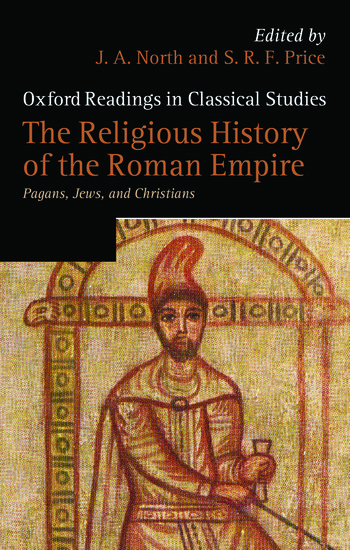
The Religious History of the Roman Empire - Pagans, Jews and Christians (J. A. North, Emeritus Professor of History, University College London, and S. R. F. Price, Emeritus Fellow, Lady Margaret Hall, Oxford), 608.p. appeared in may, 2011. and it is the newest synthesis about Roman Religion. With four chapters and seventeen articles by the greatest names in the field, the book is a good introduction to the Roman Religion (by the way, very similar to the Blackwell Companion to the Roman Religion, 2007, sometimes using the same methods- as one of the co-authors, Jörg Rüpke also mentioned in his introductory article).
Abstract of the book from the site of the OUP:"This collection of papers, many of them either published here in English for the first time or previously available only in specialist libraries, deals with the religious history of the Roman Empire. Written by leading scholars, the essays have contributed to a revolutionary change in our understanding of the religious situation of the time, and illuminate both the world religions of Christianity and Judaism and the religious life of the pagan Empire in which these developed and which deeply influenced their characters. No knowledge of ancient languages is presupposed, so the book is accessible to all who are interested in the history of this crucial period."(loc.cit.)
Table of contents:
John North & Simon Price: Introduction
I. Changes in Religious Life: Roman and Civic Cults
1: Jörg Rüpke: Roman Religion and the Religion of Empire: Some Reflections on Method
2: Richard Gordon: The Roman Imperial Cult and the Question of Power
3: J. B. Rives: Magic in Roman Law: The Reconstruction of a Crime
4: William Van Andringa: New Combinations and New Statuses: The Indigenous Gods in the Pantheons of the Cities of Roman Gaul
5: Nicole Belayche: Hypsistos: A Way of Exalting the Gods in Graeco-Roman Polytheism
6: Andreas Bendlin: On the Uses and Disadvantages of Divination: Oracles and their Literary Representations in the Time of the Second Sophistic
II. Elective Cults
7: Simon Price: Homogeneity and Diversity in the Religions of Rome
8: Giulia Sfameni Gasparro: Oriental Mysteries and Cults: A Problem in the History of Religions
9: Richard Gordon: Ritual and Hierarchy in the Mysteries of Mithras
10: John Scheid: Community and Community: Reflections on Some Ambiguities Based on the Thiasoi of Roman Egypt
III. Coexistence of Religions, Old and New
11: Philip Harland: Acculturation and Identity in the Diaspora: A Jewish Family and 'Pagan' Guilds at Hierapolis
12: Martin Goodman: Josephus and Variety in First-Century Judaism
13: Judith Lieu: The Forging of Christian Identity and the Letter To Diognetus
14: Guy G. Stroumsa: Purification and its Discontents: Mani's Rejection of Baptism
15: J. A. North: Pagans, Polytheists and the Pendulum
IV. Late Antiquity
16: Averil Cameron: Early Christianity and the Discourse of Female Desire
17: Peter Brown: Enjoying the Saints in Late Antiquity


Related works in this topic:


2011. október 30., vasárnap

Studying Roman Religion - brief history of research

Varro, the father of
the study of Roman
Religion
Georg Wissowa
The scientific study of Roman Religion is strict related to the history of religious studies itself (Religionswissenschaft). Studying "religion" was always a delicate topic, and nowadays there are a library full bibliography about it, using the same methods (historical, phenomenological, psichological, sociological, philosophical approach of the topic) as in the general study of religions (Pettazonni, Eliade, Bianchi, Hinnells) sometimes with interesting exceptions (Charachidze's contrastualism). 
This phenomenon begins in the ancient times: Greek, Etruscan and Roman auctors examined Roman religion as a socio- cultural or theological phenomenon (Varro, Hecataeus, Herodotos, Cicero, the mythographs etc.).
Franz Altheim
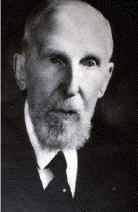
The scientific research begins in the XVIII. century with German theologists, such Johann Adam Hartung or Friedrich Scheiermacher. In the XIX. century the study of Religion - especially after the evolution of archaeology as science and the huge influence of Freud, Darwin and the translation of ancient Oriental literature - European conception about religion changed radically (Frazer, Taylor). In this period was written the basic work of Georg Wissowa about Roman religion (Religion und Kultus der Römer) which is even today highly circulated and became a modell for other major works such as of Kurt Latte or Franz Altheim. A great step in the history of religious studies was the activity of the patriarch of the Oriental Studies, Franz Cumont 
John Scheid
Nowadays the research of Roman Religion became so sophisticated and highly elaborated, that it could be a separate science in the field of classical studies. His affiliation is also difficult: the methodological approach of a religious phenomena or object are in dispute of cognitive archaeology, historian of religions, art historians and classicists also. 
In the latest monograph about Roman Religion (Jörk Rüpke, A Companion to the Roman Religion, Blackwell 2007) we can see the main areas and chief personalities of research.
Marteen Vermaseren, Robert Turcan, Ramsey McMullen, Roger Beck, Richard Gordon, Manfred Clauss, Giulia Gasparro, John Sheid, John North, Jörg Rüpke, Mary Beard, Ando Clifford, Andreas Bendlin are just few of the most citated scholars of the field. 
As Robert Phillips III. (who is the chief researcher in the historiography of Roman Religion after H.J. Rose and R. Schilling) argued in his articles, there is still no unanimously accepted method in the study of Roman Religion, because of it's doubtful place between archaeology, history of religion and anthropology.